
Product Description
Product Description
1. Leaf chain conform to ISO, BS, JS and other standards
2. Mainly BL, AL, LL, FL series leaf chain
3. Our leaf chain customization service can be provided according to customer requirements
4. The leaf chain is made of high quality material and heat treatment technology.
5. The products are widely used in forklifts, textile machinery, drilling rigs, etc. to achieve vertical lifting, horizontal traction and other uses.
Available materials
1,Stainless steel: stainless steel 304, 316, etc.
2. Alloy steel: 45 Mn, 42 CrMo, 20CrMo, etc.
OEM according to your requirements
Surface treatment: polished, galvanized, nickel-plated, etc.
Design standard: ISO DIN ANSI according to customer’s drawing requirement
Certificate: ISO9001:2008
Leaf chain structure
Leaf chain consists of chain plate and pin only. The chain plates are connected by pins to carry the tension on the chain plates. The outer chain plate is overfitted with the pin and the pin is riveted.
The inner chain plate, middle chain plate and pin are sliding fit.
Scope of Application
The plate chain is widely used in forklift, textile machinery, traction, tensioning chain, etc.
Product Attribute
|
Usage |
Transmission Chain |
|
Material |
Alloy/Carbon Steel |
|
Surface Treatment |
Galvanized / nickel plated / stainless steel / carbon steel |
|
Feature |
Heat Resistant |
|
Chain Size |
1/2″*3/32″ |
|
Structure |
Leaf Chain |
|
Color |
CHINAMFG Color |
|
Structure (for Chain) |
Roller Chain |
| Port |
ZheJiang |
| Payment |
L/C, T/T, D/P, Western Union |
| Package |
Carton, Wooden Case |
Detailed Photos
Product Parameters
Our Advantages
Company Advantages:
Own Import & Export License, The TV trade mark registered successfully in many countries, Sales network spread all over China, Products export to 65 countries in 5 continents.
Membership:
1. The member of China General Machine Components Industry Association.
2. The member of China Chain Transmission Association.
3. The member of China Chain Standardization Association.
4. The member of China Agricultural Association Machinery Manufacturers.
With our excellent trained staffs and workers, advanced and efficient equipments, completely sales network, strict QA systems. You are confidence that our premium qualified chain can meet all customers’ specification and strictest quality standards.
Please do not hesitate to contact us for more information on how TransVision products can meet your industries demands at highly competitive pricing.
Quality First, Clients Uppermost.
Product Categories
| WHY CHOOSE US |
Comprehensive Product Portfolio We produce and supply a wide range of power transmission
products including drive chains, leaf chains, conveyor chains, agricultural chains, sprockets, and
couplings. This one-store-for-all shopping experience will significantly reduce your searching costs while
guarantee youfind what you want at 1 click.
Value Choice Products Our products are the best combination of quality and price, and you get what
you want within your budgets
Seasoned Sales Associates and Engineers We have 15 seasoned sales associates and 5 engineers;
on our team at your disposal any time when you need a helping hand. They are well trained with industry
know-now and will always respond to your requests within 24 hours.
100% Customer Retention Rate Our regular customers from overseas come back not just for our
premium quality products, but for the superior services that we’ve provided over the years.
| FAQ |
| Q1: What’s your average lead time? A: It varies. Our regular end-to-end lead time is 1-2 months.. We also provide express shipments for rush orders. For details,please consult our sales associate. Q2: Is your price better than your competitors given the same quality? Q4: Can we inspect the goods before shipment? Q5: What kind of payment method is acceptable for your mill? Q6: What if I have any other questions? |
/* March 10, 2571 17:59:20 */!function(){function s(e,r){var a,o={};try{e&&e.split(“,”).forEach(function(e,t){e&&(a=e.match(/(.*?):(.*)$/))&&1
| Usage: | Transmission Chain, Conveyor Chain |
|---|---|
| Material: | Alloy |
| Surface Treatment: | Electroplating |
| Samples: |
US$ 2/Piece
1 Piece(Min.Order) | Order Sample |
|---|
| Customization: |
Available
| Customized Request |
|---|
.shipping-cost-tm .tm-status-off{background: none;padding:0;color: #1470cc}
|
Shipping Cost:
Estimated freight per unit. |
about shipping cost and estimated delivery time. |
|---|
| Payment Method: |
|
|---|---|
|
Initial Payment Full Payment |
| Currency: | US$ |
|---|
| Return&refunds: | You can apply for a refund up to 30 days after receipt of the products. |
|---|
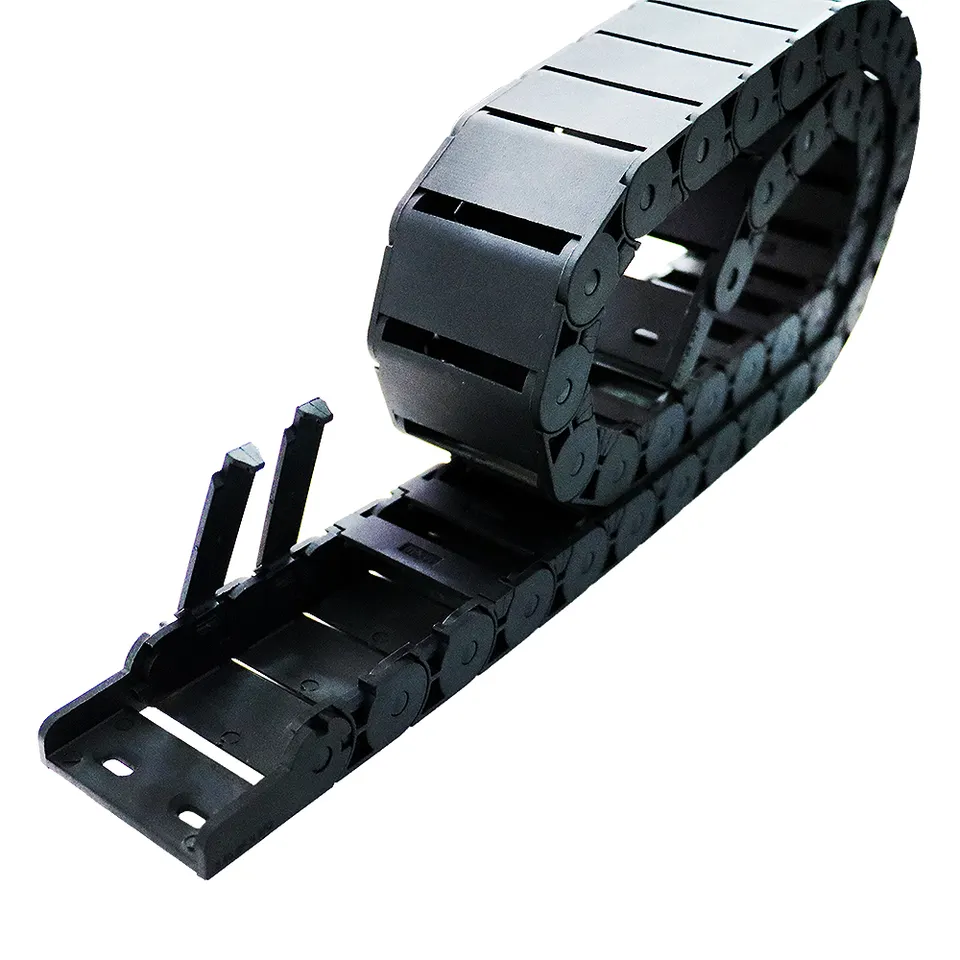
How do drag chains handle side loads and lateral forces?
Drag chains are designed to handle various mechanical forces, including side loads and lateral forces. These forces can occur during the movement of cables and hoses within the drag chain, especially in applications where the drag chain travels along curved or complex paths. Drag chains employ specific design features to effectively manage side loads and lateral forces:
- Rugged Construction: Drag chains are typically constructed from robust and durable materials, such as high-strength plastics or metal alloys. This construction provides the necessary strength and rigidity to withstand side loads and lateral forces without deformation.
- Link Design: The links or segments of the drag chain are often shaped and interconnected to allow for flexible movement while maintaining stability. The design prevents binding or jamming when the chain bends or changes direction.
- Bumper Stops: Many drag chains incorporate bumper stops or dividers within the chain’s interior. These stops help to guide and separate the cables and hoses, preventing them from coming into contact with each other and minimizing the risk of entanglement and wear.
- Tension Management: Proper tension management is essential to ensure smooth movement of the cables and hoses within the drag chain. Tensioning devices or systems can be used to maintain the appropriate level of tension, preventing excessive sagging or bunching that could lead to interference or damage.
- Side Mounting Brackets: In some applications, side mounting brackets can be used to provide additional support to the drag chain, reducing the effects of side loads and lateral forces.
It is crucial to select the appropriate type and size of drag chain for the specific application to ensure it can handle the expected side loads and lateral forces. Regular maintenance, inspection, and lubrication are also essential to prolong the drag chain’s life and optimize its performance in managing mechanical forces during operation.
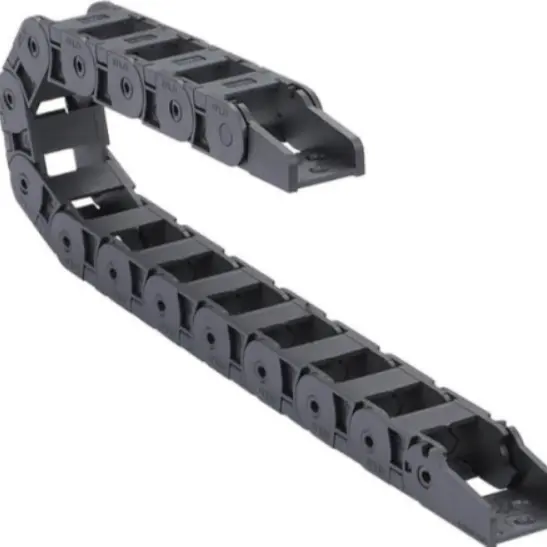
How do drag chains handle cable routing and cable organization?
Drag chains play a crucial role in cable routing and cable organization in various industrial applications. They are designed to efficiently manage and protect cables and hoses, ensuring smooth movement and preventing damage. Here’s how drag chains handle cable routing and organization:
Enclosed Cable Routing:
Drag chains provide an enclosed pathway for cables and hoses, keeping them organized and preventing tangling or entanglement. This enclosed design ensures that cables are neatly arranged and protected from external elements, such as dust, debris, and contaminants.
Smooth Cable Movement:
The interior of drag chains is designed to provide smooth movement for the cables and hoses passing through them. This reduces friction and minimizes wear and tear on the cables, prolonging their lifespan and ensuring reliable operation.
Multiple Cable Compartments:
Many drag chains have multiple compartments, allowing for the separation and organization of different types of cables and hoses. This makes it easier to identify and replace specific cables when needed, streamlining maintenance and reducing downtime.
Adaptability to Cable Sizes:
Drag chains can accommodate various cable sizes and types, making them versatile and suitable for a wide range of applications. The chains can be customized to fit specific cable diameters, ensuring a secure and snug fit for each cable passing through.
Protection from Hazards:
Drag chains shield cables and hoses from potential hazards, such as sharp edges, moving machine parts, or exposure to chemicals. This protection prevents damage and ensures the safety of both cables and personnel working near the equipment.
Cable Length Compensation:
As machines and equipment move, the cables and hoses within them need flexibility to adjust to different positions. Drag chains provide the necessary cable length compensation, allowing the cables to extend and retract smoothly without becoming tangled or causing strain.
Preventing Cable Clutter:
By keeping cables and hoses organized within the drag chain, cable clutter is minimized. This not only improves the overall aesthetics of the equipment but also makes it easier to identify and troubleshoot any cable-related issues.
Overall, drag chains are essential components in industrial cable management systems. They streamline cable routing, protect cables from damage, and ensure smooth movement, contributing to the efficient and reliable operation of machinery and equipment in various industries.
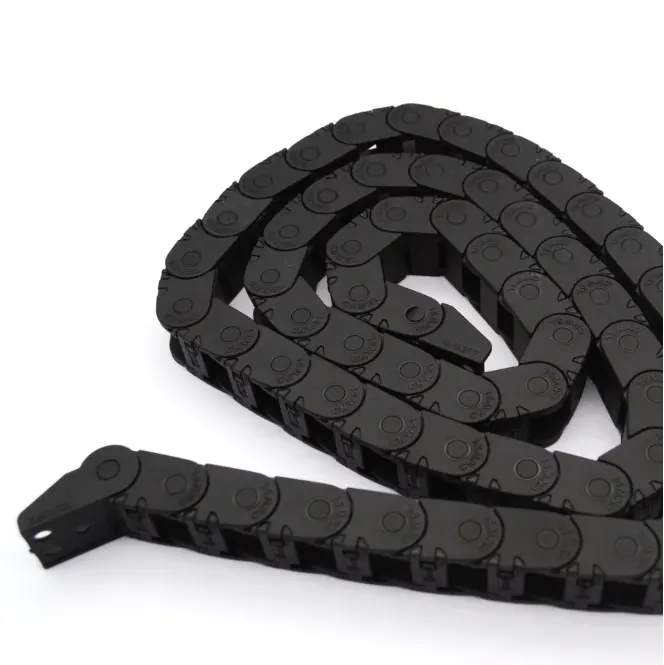
How do drag chains prevent cable wear and ensure smooth cable movement?
Drag chains, also known as cable carriers or cable chains, play a crucial role in protecting cables and hoses while ensuring their smooth movement in industrial applications. Here’s how they achieve this:
1. Enclosed Design:
Drag chains have an enclosed design with a series of interconnected links that form a protective channel for the cables and hoses inside. This design prevents external elements like dust, debris, and liquids from coming into direct contact with the cables, reducing the risk of abrasion and wear.
2. Cable Separation:
The individual links in the drag chain keep the cables and hoses separated from each other, preventing them from getting tangled or rubbing against each other. This separation minimizes friction and wear between the cables, ensuring their longevity.
3. Cable Support:
Drag chains provide excellent support for the cables and hoses they carry. The cables rest on the bottom of the chain’s channel, and the smooth movement of the chain prevents excessive bending or twisting, reducing the stress on the cables and prolonging their life.
4. Low Friction Materials:
High-quality drag chains are made from low-friction materials like nylon or plastic, reducing the friction between the cables and the chain itself. This feature ensures that the cables can move freely inside the chain without experiencing excessive wear.
5. Tension Adjustment:
Many drag chains allow for adjustable tension, which means that the user can adjust the tightness of the chain according to the number and size of the cables or hoses. Proper tension prevents slack and excessive movement, reducing the risk of wear due to movement-related stress.
6. Suitable Material Selection:
Choosing the right type of drag chain and material is essential to prevent cable wear. The chain’s material should be compatible with the cables it will carry and the environmental conditions in which it will operate. Stainless steel, plastic, and hybrid materials are commonly used for different applications.
7. Regular Inspection and Maintenance:
Regular inspection and maintenance of drag chains are vital to ensure their optimal performance. This includes cleaning the chain, checking for any signs of wear or damage, and making any necessary adjustments or replacements.
In conclusion, drag chains prevent cable wear and ensure smooth cable movement by providing an enclosed, separated, and well-supported channel for the cables and hoses. The right material selection, tension adjustment, and regular maintenance further contribute to the effective protection and longevity of the cables in industrial applications.


editor by CX 2024-01-08